
Coaching vs. Therapy: What’s the Difference and Which One Do You Actually Need?
Let’s get one thing straight before we go any further: wellness coaching and psychotherapy are not the same thing. Not even close. And if you’ve been using the terms interchangeably, you’re not alone — but it’s worth clearing up, because choosing the wrong one can leave you spinning your wheels and wondering why nothing is changing.
I get asked about this constantly, and honestly, I love that people are asking. It means you’re thinking critically about the support you’re investing in. So let’s break it down in plain English, no clinical jargon, no fluff.
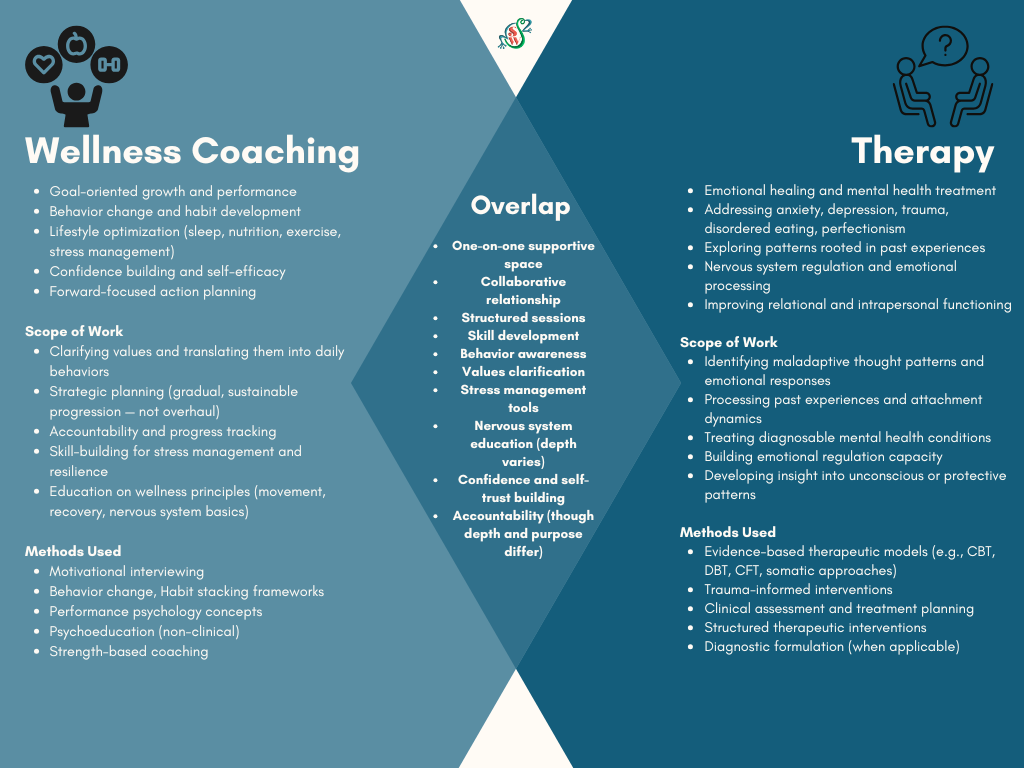
Wellness Coaching v. Therapy
Coaching: For When You’re Already Functional and Ready to Move
Wellness coaching is where we go when you’re not in the weeds.
You’re operating, you’re showing up, but something isn’t clicking the way you want it to.
Maybe you know exactly what you should be doing and just aren’t doing it.
Maybe you’ve got the information but zero follow-through.
Maybe you’re a high achiever who’s crushing it at work and falling apart everywhere else.
Coaching is forward-facing. We’re not spending a lot of time dissecting your past. Instead, we’re looking at where you are right now, where you want to go, and building the bridge between the two. That means clarifying what actually matters to you, translating those values into daily habits, and creating a structure that doesn’t make you want to throw your phone across the room by week two.
The clients who get the most out of coaching are the ones who are ready to act. They don’t need hand-holding. They need a plan, a system, accountability, and someone who will call them on their nonsense when they start making excuses – and to be in their corner when things get rough.
If you’ve ever caught yourself saying “I know what to do, I just don’t do it” - that’s coaching territory.
To be clear: coaching does not diagnose or treat mental health conditions. It is not clinical treatment. There are no mental health records, no insurance billing for mental health services, and no formal diagnostic process. That’s not a limitation - it’s more advantageous, to be honest; but, knowing that distinction matters.
Despite coaching not having distinct guidelines for client protections, at Sapo Wellness confidentiality and ethical guidelines practiced under the therapy umbrella are applied to wellness coaching clients, too. Client confidentiality is of the utmost importance regardless of service received.
Wellness Coaching, specifically….
Wellness coaching at Sapo isn't what most people picture when they hear the word "coaching." If you've spent any time in the fitness or online health space, you probably associate coaching with someone handing you a meal plan, plugging your numbers into a macro calculator, and sending you a workout program to follow.
That's not this.
My coaching framework is built around the pillars of Wellness - physical health, nutrition, sleep, stress, relationships, environment, purpose, and mental and emotional well-being - because real, lasting change doesn't happen when you only fix one thing and ignore the rest.
That means this isn’t a done-for-you situation. You will get guidance and support with your areas of growth, but we’re not here to do the work for you. We're here to build the skills, awareness, confidence and structure that make you capable of doing it yourself.
What you will get is an honest look at where your life needs upgrading, a framework for understanding why, and a plan that you build with me - not one that gets handed to you and forgotten by week three.
Psychotherapy: For When Something Deeper Is Running the Show
Therapy is a different animal. We’re not just talking about habits and performance here - we’re talking about all the stuff underneath.
Anxiety that won’t quit.
Patterns you keep repeating no matter how many times you tell yourself you’re done with them.
Trauma that shows up uninvited.
A relationship with food or your body that has become a full-time job.
Depression that makes basic functioning feel like moving through concrete.
Therapy gets into the root system. We look at where patterns came from, how your nervous system learned to respond the way it does, and how those old strategies are now working against you. It’s slower, it’s deeper, and for a lot of people, it’s the work that makes everything else actually stick.
Therapy is provided by licensed or supervised clinicians, it’s governed by ethical and legal standards, and it can involve formal diagnosis when that’s appropriate and useful. It can also be longer-term, because undoing years of patterned responses doesn’t happen in eight sessions. If you’re experiencing clinical symptoms - real distress, real impairment - this is where you need to start.
So Where Do They Overlap?
Here’s the part that makes my work interesting and sometimes confusing to explain at dinner parties.
Coaching and therapy share some real estate.
Both involve a one-on-one relationship built on trust.
Both use skill-building, psychoeducation, and behavior awareness.
Both care about stress management, self-trust, and nervous system regulation.
The difference is the depth, the clinical scope, and the purpose behind the work.
Think of it this way: coaching builds capacity. Therapy treats the barriers to that capacity.
Sometimes those happen at different points in someone’s life. Sometimes they happen simultaneously with separate providers. In my practice, because I hold both a clinical license and coaching credentials, I’m able to hold both worlds, but they are always kept clearly distinct in terms of scope, structure, and documentation.
Not Sure Which One You Need?
If you’re showing up to your life and you just want to perform better, feel better, and stop self-sabotaging the things you actually care about, coaching is probably your entry point.
If you’re struggling - really struggling - with anxiety, mood, trauma, or patterns that feel completely out of your control, therapy is where we start. Not because you’re broken, but because you deserve support that actually matches the level of what you’re carrying.
And if you’re still not sure? Reach out to schedule a strategy session (aka consultation) so e can figure it out together.
Let’s get moving.
— Sasha
SAPO Wellness | LPC-A | CSCS, MS Exercise Science, MS Clinical Mental Health Counseling