
Habits - How They Form & Why They’re So Hard to Change
You look up from your phone to take a sip from your fresh cup of coffee.
It’s cold now. Sigh.
You realize you’ve been doomscrolling for 45 minutes. Your hair still isn’t brushed, your toast is burnt, and you should have left for work 10 minutes ago. Great, now you’ll really be late.
You knew this would happen – it’s the third time this month - and it’s only the 8th.
You told yourself you wouldn’t grab your phone until you were out the door, and yet…
If you’ve ever experienced something similar, you’re far from alone.
You may be asking yourself, “why do I still choose bad habits, even when I know they’re not good for me?”
The answer isn’t a lack of willpower or weak character.
Your brain and its endless pursuit of efficiency is to blame. Let’s discuss.
Before we can dive into the nuances of habits, we must first understand the structure within which this is all happening.
The organic mega-machine that drives all our liveliness – your brain - is lazy as f*ck. Keep this in mind as we go through this whole process.
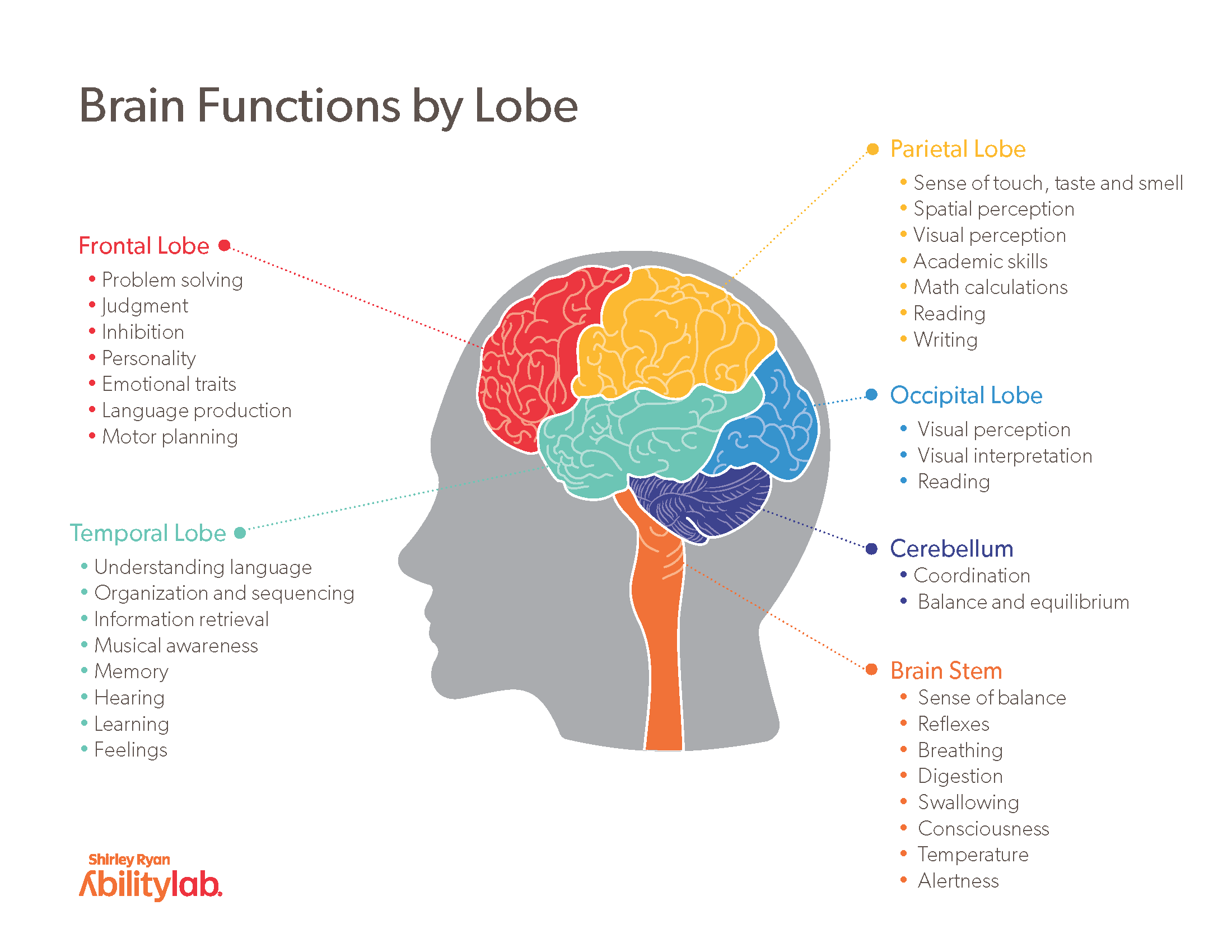
Your brain is separated into four primary lobes (frontal, parietal, temporal, and occipital). These lobes work in tandem to ensure all your motor and cognitive functions operate in tip-top shape. Your brain stem and cerebellum are also included, but these are more for the fully automatic processes like breathing and balance.
The frontal lobe is the largest lobe and lies at the – you guessed it – front of the brain. It’s home to the pre-frontal cortex (PFC) - which acts as the command center for higher-level functioning - and is managed by the executive function system (aka the director). The executive function system is responsible for voluntary movement, planning, rule-based problem solving, decision-making, emotional regulation, working memory… quite a lot, to say the least.
Your parietal lobe lives in the middle of your brain and is responsible for processing sensory data. The temporal lobe is located on the sides of the head near the ears and involves auditory processing and memory, whereas the occipital lobe is at the back of your brain and is dedicated almost entirely to vision.
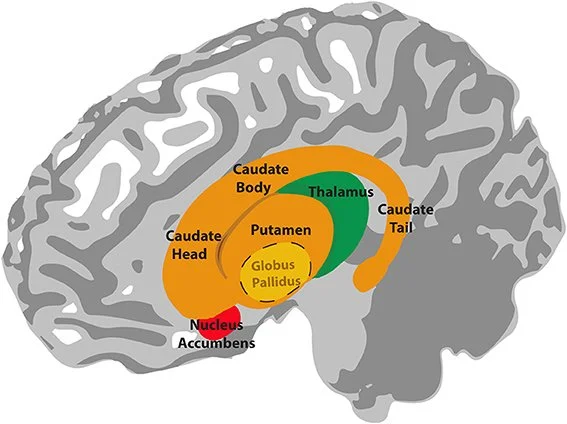
Woven amongst these lobes lies the basal ganglia (BG), which serves as a subcortical hub connecting the brain’s regions. The BG are not solid structures but rather are clusters of nerve cell bodies that act like a circuit board forming inhibitory (signal dampening) and excitatory (signal action) connections and circuits within different areas of the brain.
The basal ganglia work closely with the frontal lobe in a continuous loop to control movement, thoughts, and behaviors. This area acts like behavior storage, since the BG are what “allow” or “block” actions from happening in the first place, then store behaviors for later recall. BG achieve this status by working intimately within the rewards system and are the brain’s primary destination for dopamine.
Okay, now that we have the visuals, let’s talk process.
Habits – How They Form
Behavior is any action that was taken in response to a stimulus. A habit is formed when specific behaviors are repeated often enough that they become automatic.
The reward system - otherwise known as the dopamine motivation loop – drives habit formation.
When the brain picks up on a possible reward afoot, a structure called the ventral tegmental area (VTA) - located near the BG - releases a spike of dopamine. This tells your brain to pay attention to the possible reward and drives the initial surge of momentum towards action. This spike is thrown in anticipation of the reward, not the feeling of pleasure in actual achievement.
The frontal lobe (prefrontal cortex, specifically) notes the spike and starts planning behaviors to get the reward. The PFC and BG correspond; BG will send an excitatory, or approval signal if the proposed behaviors are satisfactory and the PFC can proceed with actions, or the BG will block any actions via inhibitory signals that are deemed dangerous, irrelevant, or inappropriate.
Once an approved action(s) is determined, all focus and attention go towards finishing.
Completing the action(s) releases endorphins which bring feelings of pleasure and satisfaction. The BG note this and send out another surge of dopamine as a stamp of approval to close the loop and remember the action(s) for future use.
With repetition of the same action(s) the prefrontal cortex calms down and stops planning upon cue. Instead, it delegates to the striatum within the basal ganglia. Behavior becomes purely stimulus-driven, with neurons firing from the BG the most at the beginning and end of the loop to frame and organize the behavior(s). It then compresses and stores routines.
Voila, you have a new habit.
The Reward Loop TLDR (primary steps in red):
Cue 🡪
Dopamine sparks action (VTA) 🡪
Behavior/Action (the routine/action after cue) 🡪
Reward/Payoff 🡪
Storage (BG fires dopamine stamp of approval)
Rinse and Repeat.
Why Habits are Habits
Earlier I mentioned your brain’s laziness – the basal ganglia storage system is one of the places your brain likes to implement those energy-saving shortcuts.
The BG chunks physical actions/behaviors into whole units instead of steps. That means when you see your cue, you recall the entire automatic routine instead of just portions; this is the reason neuron activity is higher at the start and end of each loop. By doing this the BG conserves energy, both for storage and recall, and allows for autopilot to engage. Each round of storage strengthens the neural pathways the routine is set in making it easier and easier to recall when prompted.
It’s why you know to grab your keys and head to the gym (action) after putting your running shoes on (cue) instead of tying your shoes then running to load the washing machine.
Behaviors practiced over and over are stored and labeled as automatic processes. They are not assigned morality or ethics. They are simply actions that have been repeated so often that they can be recalled and practiced without much thought. Most importantly, they are energetically inexpensive.
This system is highly efficient for habit formation. It is also why breaking them is so tough.
Differences in Systems: Neurodivergent Reward Loops
Habit formation is fairly simple in theory and can be manageable despite its stressors. However, neurodivergent populations may have different, more frustrating experiences when it comes to their reward systems.
Take those with Attention-Deficit Hyperactivity Disorder (ADHD). ADHDers tend to have less sensitive dopamine receptors and do not produce the initial dopamine spike as efficiently as their neurotypical counterparts. In some cases, they may not produce it at all. Therefore, ADHDers often struggle to produce the momentum necessary to initiate tasks (never mind completing them!). No anticipatory spike = no signal for action.
The action step is not a natural next progression after the initial dopamine spike because there is no spike. Thus, interest must drive action for an ADHDer. The promise of later reward is not enough to sustain behaviors; like the basal ganglia, ADHDers tend to live in the moment and forego any promises of long-term rewards, so novelty is needed to engage action.
Note: This mechanism is why ADHDers often engage in stimulation-seeking behaviors, even if risky. Novel, or new, experiences get more noticeable dopamine hits than older or expected ones.
For ADHDers, rewards do not often come in endorphins or feel-good chemicals. Instead, reward is often overshadowed by panic. Stress hormones like cortisol and adrenaline are relied on instead of dopamine to initiate and complete tasks; the task may get done but the primary feeling after may be relief, not reward.
Hacking the System
Changing a habit requires intention. The brain that has already built an inexpensive resource is going to resist spending mental energy to build a new task, favoring the “if it ain’t broke, don’t fix it” loop. But it is broke, brain. That’s why we’re here.
Let’s revisit the primary steps of the reward system so we know where and how to interrupt it for new things.
Cue 🡪 Behavior/Action 🡪 Reward/Payoff
MIT researchers discovered something fascinating about habits. Even when you successfully quit a behavior, your brain doesn’t completely delete the old habit loop. Instead, the basal ganglia stores it away, primed to reactivate when the right cue appears. The old pathway may be dormant, but it isn’t gone.
Let’s consider a scenario.
Imagine you’ve spent years trapped in an endless cycle of scrolling. Every spare moment - waiting in line, sitting at a red light, standing in the grocery store checkout - your hand instinctively reaches for your phone. Then you start reaching for it in meetings, during dinner, while driving… Eventually, you decide you’ve had enough. You silence notifications, remove social media apps from your home screen, and become intentional about how you spend your time. Weeks pass. Your screen time drops dramatically. The urge fades. It feels like you’ve broken free.
Then a stressful week hits.
You’re sitting at work when a familiar notification sound cuts through the room. A coworker’s Facebook Messenger pings from across the office. Before you’ve consciously registered what happened, your hand is already on your phone. Within seconds, you’ve unlocked the screen and opened the app. It feels almost automatic, as if some hidden part of your brain recognized the cue and dusted off an old set of instructions that had been waiting patiently in storage.
This happens because that stored habit loop is cheap in brain energy – remember, your BG won’t spend more on a new habit when resources are already depleted from stress.
Knowing that the BG cannot erase cues, the only other option is to reassign the proceeding action. Reassigning means intentional friction must be applied while activating the BG’s “brake” system to interrupt the automatic process retrieval. Doing this brings the prefrontal cortex back online. It also means you’re asking a lot from yourself – you need planning, focus, thought – and these are costly, and your brain WILL resist, so this is where giving yourself some grace is a non-negotiable.
Reassigning Habit Loops Process
Step 1 - Identify your cues.
Step 2 - Pause for 5-10 seconds. This engages the BG “brakes.”
Step 3 - Apply the friction – resist and redirect from the old habit.
Step 4 – Flood the striatum with dopamine by creating immediate rewards for the new habit. This forces the BG to consider other options for the cue and start forming new neural loops for them.
Step 5 – Repeat, repeat, repeat.
Let’s revisit the social media example to put it into perspective.
You hear your coworker’s Facebook Messenger notification (step 1) and immediately feel the urge to check your phone. Instead of acting, you pause for 5–10 seconds (step 2). Then, rather than opening social media, you redirect by walking to the cooler to refill your water bottle and take a long, refreshing drink (step 3). You need to hydrate more anyway.
When you return to your desk, you mark the habit as completed in your tracker and enjoy the dopamine hit from the sense of accomplishment (step 4). You do a little jig. You just started the new loop formation.
The more often you repeat this process (step 5), the more your brain learns that the notification ping no longer means “open social media.” Instead, it now means “take a quick water break.”
Hell yeah.
Closing Thoughts
I wrote this article with the goal of bringing awareness to this process so someone could use it to reframe their own approach. I’m sure I’m not alone in my experience of starting a habit, willing yourself to do it, bargaining when motivation dips, trying again, then finally letting the new habit go because it just couldn’t gain any traction.
Or, finding yourself trying to keep up with your established habits when life presents competing interests, or you’ve accumulated too much stress..
Initially, I blamed myself, my character; I wasn’t strong or focused enough and that’s why I kept failing. All shame-based, none of it helpful.
But brains are lazy. They’re going to pick the most energy-efficient route to complete a task, even if it’s not one you prefer. Moving the brain-train onto different tracks is high in mental energy cost.
Understanding how our brains work and learning to move with them, not against, can help us bring more self-compassion into our lives. The frustration will still be there but managing it may be easier; expecting it makes it easier to tackle when it hits.
Now that I understand this, I can offer myself a little bit more grace. I hope you can, too.
Take care of yourselves. Let’s get moving.
— Sasha
References
Ashby, F. G., Turner, B. O., & Horvitz, J. C. (2010). Cortical and basal ganglia contributions to habit learning and automaticity. Trends in Cognitive Sciences, 14(5), 208–215. https://doi.org/10.1016/j.tics.2010.02.001
Anatomy of the basal ganglia.jpg - Wikimedia Commons. (n.d.). https://commons.wikimedia.org/wiki/File:Anatomy_of_the_basal_ganglia.jpg

Habits form far faster than science previously thought, research shows. (2026, June 3). The Hub. https://hub.jhu.edu/2026/06/03/habits-form-faster-than-previously-thought/
How the brain controls our habits. (2012, October 29). MIT News | Massachusetts Institute of Technology. https://news.mit.edu/2012/understanding-how-brains-control-our-habits-1029
Professional, C. C. M. (2026, February 10). Basal ganglia. Cleveland Clinic. https://my.clevelandclinic.org/health/body/23962-basal-ganglia
Understanding the parts of the brain. (2023, March 10). Shirley Ryan AbilityLab. https://www.sralab.org/articles/blog/understanding-parts-brain
Zanten, C. (2025, May 2). How to Break Bad Habits: A realistic guide for ADHDers. ADDA - Attention Deficit Disorder Association. https://add.org/break-bad-habits/